Becoming an Ironman
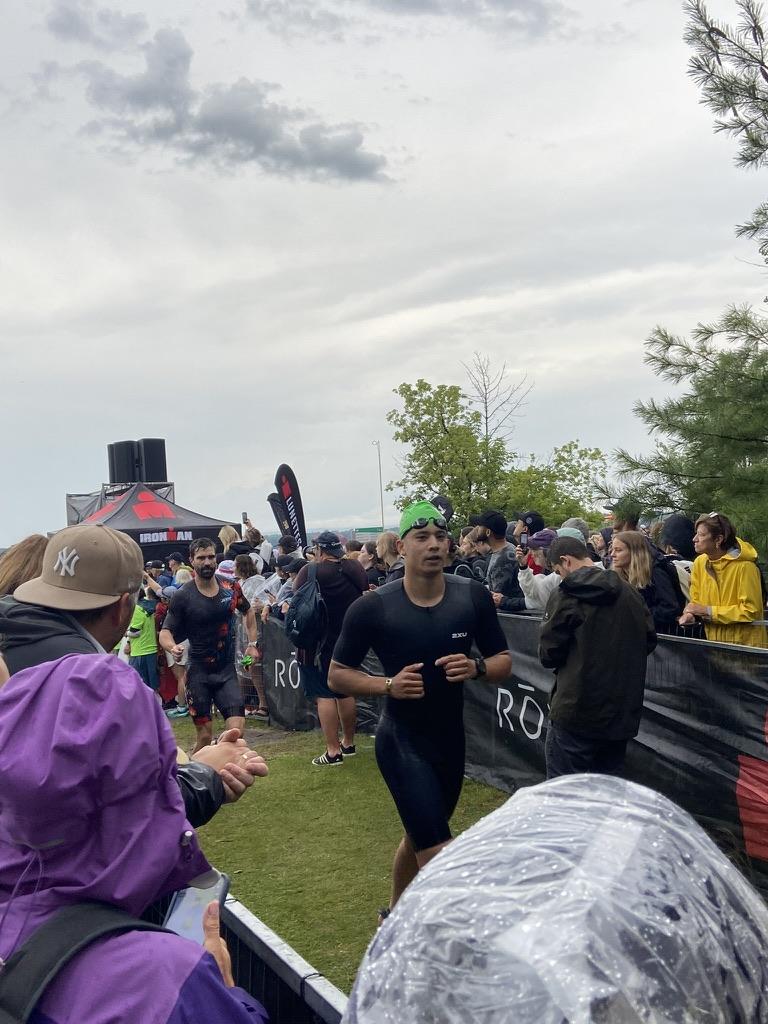
There I was running the Ironman marathon leg. In the rain, with fatigued legs, bloodied socks, wet shoes, a sore back, ice under my hat, ice in my tri-suit, and gels at the ready; I was reflecting on the hours spent training, researching, and money spent to become an Ironman.
It was just over 8.5 hours into the race, and my body was in pain. The swim, 3.8km, resulted in a chafed my neck and drained arms. The bike, 180km, resulted in a sore butt, a sore back, and legs primed to cramp if I dare jump. Now 15km into the run, 42.2km in length, I felt good tackling the final frontier.
With 27km to go, I was thinking how my race strategy had gone to plan in terms of nutrition, pace, and intensity. I was on target to hit my sub 11 hour race goal. In roughly 6 km, I had the energy to increase the intensity and finish strong.
That never happened.
Instead, at the 17km marker, my stomach was giving me good grief and I found myself in the porta-potty moments later. I was in a bad situation, with regrets leaving my Imodium on my bike. But thankfully, I had a personal needs bag only 4km away with peptic acid, which should soothe my stomach. I just had to make it there.
Running with the runs, no big deal right?
Exiting that porta-potty, I went from a bad situation to worse. Every step I took shook my stomach. I had to resort to a run/walk combination to make it to my personal needs bag. Finally, I made it there, took the medicine, and was on my way.
I ran, walked, hobbled, praying and wondering when it’d kick in. Then 10 minutes later, my stomach keeled again, and I found myself in another porta-potty. I needed Imodium, not peptic acid, and I had no Imodium.
A sense of dread seeped in. I messed up. Somewhere in my race strategy and preparation I made a combination of errors that resulted a blown up race 200km in. Now I was wondering if could even finish the race. My mind was telling me to quit, to give up, and my stomach was screaming in agreement.
Let’s rewind a bit.
How I Got Into This Mess
There are a few components to consider for an Ironman such as swimming, cycling, running, equipment, fuelling, preparation, and strategy. Upon reflection, I made errors in my fuelling plan and equipment.
It takes time to train your gut to handle nutrition absorption. You have to consider hydration, electrolytes, and carbohydrates. I’ve messed up in shorter races before where I’ve under-fuelled and suffer from cramps. From my research, I knew you could train the body to handle 120g of carbs per hour, and electrolytes typically depends on how much you sweat.
Over the past 10 months, I made my own gels and tweaked the formula over time to get it just right. I’d have these during my long bike rides and if it didn’t feel right, I’d adjust for the next session. But therein lies the problem.
I was training my gut on the bike, but never training my gut on the run. My long runs were typically 90 minutes in length on fresh legs and an empty stomach. I did not know for an Ironman, the fuelling rate for the run should be less than the bike.
On the bike, your stomach isn’t sloshing around. Whereas during the run, all those liquids slosh inside your stomach, and eventually your stomach tells you no. I didn’t simulate this in training - running a long distance with a liquid diet. I needed to consume more dense fuel and less fluids for the run to avoid this.
My equipment could use improvement. On the bike, I was loaded up with water bottles and fuel. My hydration solution was missing a gasket (lost during a training session), so I resorted to carrying extra water bottles. The aid stations were so frequent, I could have started my bike ride with just my fuel and got my water needs throughout the day. A lighter bike is a faster bike.
During the race, I picked up extra nutrition on the course which took me over my 120g of carbs per hour limit. I didn’t understand how this extra food would impact me later. I could have abandoned my running gels (lighten my weight) and be disciplined to grab enough aid during the course.
I also just got myself a Garmin Watch, because my Apple Watch doesn’t have the battery life to support a 4+ hour fitness activity. This was crucial, connected to my bike computer, for me to monitor my heart rate and effort. I could have also purchased a power meter, to guarantee I wasn’t cycling beyond my threshold for more instantaneous feedback.
In my transition bags, I should have packed Imodium in each one. I didn’t have scissors on hand to divvy up the pills so I kept it on my bike. I just needed to remember to take it with me for the run. After 7 hours of racing, a mental lapse in judgement, I forgot it.
The combination of these tiny errors formulated a blown up race. I was in uncharted territory with no Imodium to alleviate the symptoms. The last time I blew up in a marathon, I was dealing with severe cramps 4km from the finish line, and it took every ounce of willpower to finish.
With a half marathon left, I wanted to cry. I wasn’t going to hit my goal time. I didn’t know if I could finish. My mom, sister, and girlfriend’s family all came to Ottawa to support my race, and I was about to let them down with a DNF. I’d never hear the end of it, considering they’ve been soaking in the rain, too. I thought about the friends and family supporting me from afar, all the hours I’ve spent training, and the sacrifices I made in lieu of this endeavour.
Ironmans aren’t meant to be easy. The pain of DNF-ing this race would far exceed the pain I was in. A thought echoed in my mind, “Winners never quit, and quitters never win”. My mindset shifted. One way or another, I was going to become an Ironman before the day ended.
The Final Half Marathon
Pick your poison; cramps or porta-potty, my dilemma for the next 3+ hours.
With an empty stomach, I could run. No fuel meant cramps, forcing me to walk. Electrolytes get rid of those cramps. But, anything in my stomach forced a porta-potty visit.
While waiting at the 2nd porta-potty, I overheard someone mention they’ve made 9 visits so far. I wasn’t the only one suffering. That’s reassuring. If anything, I was doing rookie numbers and needed to pump them up.
Over the next couple of hours, I trudged along porta-potty by porta-potty. Each time needing to remove my tri-suit, contemplate my life decisions within the 4 green walls, and having to put the wet tri-suit back on.
Finally, after my 6th porta-potty visit, roughly 5kms from the finish line, I was numb to the pain. I didn’t know how long it had been, but I made it the goal to finish under 13 hours.
Parliament Hill was near the end of the race, a steep incline. I knew my best chance of meeting this goal was to walk the hills and run the flats. Digging deep, I tapped into everything I had and didn’t stop moving.
Finally, just under 13 hours since I found myself swimming in the Ottawa river, I was finally an Ironman.